Uniquely, the cannon was discovered in the Middle East
In "The Literature Tieu Luc" by Le Quy Don wrote: "... in the Ngoc Uyen area (ie Trung Do, Bao Nhai and the surrounding area now), Vu Van Mat built the citadel and built up a rampart against the Mac Dynasty for 20 years ..."; After that, General Hoang Van Thung continued his career. Also in this area, people discovered a bronze cannon in the space of Trung Do ancient fortress that remains to this day.
Cannons are kept and preserved at the Provincial Museum.
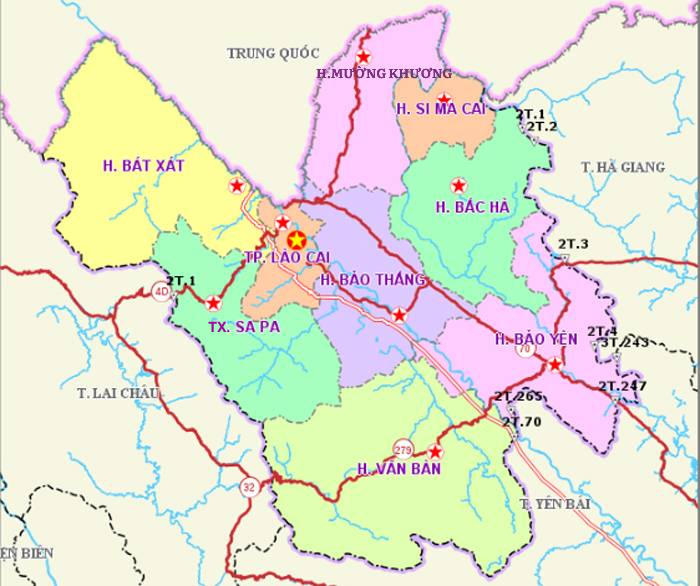
Brass cannon was discovered in Trung Do ancient citadel in Trung Do village, Bao Nhai commune, Bac Ha district in December 1997. The artifact was discovered by Mr. Giang Seo Ky, the Mong ethnic group in Trung Do village, while wandering in the fields. The gun is located at a depth of 30 cm from the ground, close to the neck of Trung Do village. Gun pose when excavating: The barrel is facing Bao Nhai Street, the gun body is placed on 3 round, solid rocks.
This artifact is being kept and preserved at the Lao Cai Provincial Museum. The gun is 2.36 m long, the diameter of the gun barrel 20 cm, the thickness of the barrel 5 cm, weight 80 kg. This is a large type of brass cannon, which is very rare in Vietnam. The gun's tail is closed, conical outward, with a rectangular key that is symmetrical, where the trigger is at the tail. The trough-shaped defect is a place to compress explosives. The gun has a round body, hollow inside, tapering up towards the barrel. At the bottom of the head, the gun has a rectangle of 11 cm long, 2 cm wide and is connected to the trough. The body of the gun has two very fuzzy Chinese characters and is difficult to read. The floating edges around the gun body (5 rings) are arranged evenly, these edges are both decorative and able to withstand the compressive strength of explosives. The body of the gun supporting the two gun shoulders was lost. The two gun shoulders are symmetrical to the sides of the body. The gun lost its base, leaving only the body of the gun.
According to researchers of antiquities and histories about Vietnam in general and artifacts in Lao Cai in particular, the owner of the ancient capital of Trung Do and the cannon is one. The event took place here associated with the owner Vu Van Mat, the Vu cousins who had contributed to the fight against foreign invaders in the border area and General Hoang Van Thung - a Nung ethnic insurgent in Trung Do village participated in the meaning army. According to the chronology examined by scientists of the Archeology Institute, the gun was born in the sixteenth century (post-Le), this was also the time to build the Trung Do base against the Mac army and the Yunnan from the reign of King Le Chieu Tong (1549 - 1556).
Researchers of history and archeology who come to research on Lao Cai have stated that: The bronze cannon was discovered in Trung Do with a large size and weight, the art of casting in sophistication, showing his father's military skills and skills in a historical period against the enemy. foreign invasions in border areas. The cannon is seen as a sacred weapon, a sacred object showing his father's advancement in warfare against foreign invaders in the defense of the country.